Tim Winton, the quintessential West Australian novelist, describes West Australia (WA) as "
Like Texas, only it's big". It's fair comment: WA occupies 2.7 million square km of the earth's surface, Texas just 0.7 million. When we
arrived in Perth after our journey from Sydney on the Indian Pacific train, we'd already got a sense of the size: it had taken us parts of two days and a full night to cross the Nullarbor from the state border. Our planned road trip from Exmouth to Perth was only a small part of WA's coastline, but 1200 km of driving. The rental agreement banned us from going more than 200km from the coast: in NZ there isn't anywhere 200km from the coast, in WA it excluded most of the state.
But before heading north, we had a day to reacquaint ourselves with Perth. On our previous visit in 1977, we'd been overcoming the culture shock of being in a western city again after 9 months crossing Asia. Now we just had to cope with finding our own way rather than relying on the train staff. From the train, we biked to
Anna's AirBnB apartment to get the keys from Diane the cleaner. As promised, the view of the Swan river from the 18th floor was stunning, particularly when I woke in the early hours to see the Moon setting over Narrows Bridge.
 |
| Breakfast on the 18th floor, Ferry terminal and Kings Park behind |
 |
| Swan River Bike trail |
Kings Park beckoned, so we biked the river side path and hiked up the aptly named
Kokoda track. One of the reasons for visiting WA in September was to see the wildflowers, and it looked like we could tick off most of the species in the flowerbeds overlooking the city. In 1977 we'd been getting used to Asians not being around, in 2016 it was hard not to photobomb a selfie destined for Guangzhou or Kuala Lumpur.
 |
| Marg, Kings Gardens, 1977 |
 |
| Marg, Kings Gardens, 2016 |
Next morning we caught the
ferry down the river to Fremantle, past $80 million Tuscan villas, and across to
Rottnest Island. Rottnest/Wadjemup, the Waiheke of Perth, turned out to also be the bike rental capital of Australia. As the crowds disembarked from the ferry, people claimed their pre-booked rental bike, grabbed a helmet from a huge bin, and cycled off to explore the Island.
Following the trend, we went clockwise, stopping first at the Kingsland Barracks, the remnants of the "Rottnest Island Fortress" defending Fremantle during the World Wars. Cycling through the tundra-like landscape, we passed an intriguing sculpture based on old bike parts, and reached the south coast beaches, which looked like they'd offer good snorkeling in more clement weather. Two Pelicans preened on one beach, and Marg found a dessicated puffer fish.
 |
| Preening pelicans ignore photobombing gull |
A detour inland took us to the Wadjemup Lighthouse, where we ate our sandwiches while we waited for the half hourly tour up the winding staircase to the machine room at the top where keepers used to wind up the weight that powered the turning light through the night. We were able to repay the guide for the knowledge she shared, by giving her a test ride on Lucie, to help her research for her own folding bike purchase.
 |
| Lenses, Wadjemup lighthouse |
 |
| Retrospective advice for Captain Cook, Wadjemup Lighthouse |
 |
| Al and Marg with Victorian ironwork on top of Wadjemup Lighthouse |
Back at the wharf, we were entertained by the endemic Quokka, the rat-like animals that gave the island its European name, and subject of numerous
Internet selfies. Their survival strategy belies their cuteness - if threatened by a predator, Mum chucks the baby out of her pouch as a distraction, and hightails it in the direction of the nearest male Quokka to restart the perpetuation of the species.
 |
| Mum checks for predators and discarded muffins, Rottnest Mall |
Back in Freemantle, we took the efficient and bike friendly train back to the city to prepare for our early flight next morning to Exmouth and Ningaloo National Park.
When booking, I'd wondered why there was a Monday 5:20am flight, even checking that I hadn't confused am and pm. When we got to the airport, the reason for the early flight became clear: squads of mine workers in fluoro overalls were checking their steel capped boots through airport security, heading back to work after their weekend at home. FIFO (Fly In, Fly Out) has replaced hard life in an outback mining settlement. Sadly, while heavy duty mining equipment was acceptable as carry on, Marg had to surrender her beloved pen knife that had accompanied her around the globe several times.
In Exmouth we collected our van, along with Clint (Eastwood) and Buddy (Holly). We'd been a bit
apprehensive as to what slogans our van would be emblazoned with (masking tape was Plan B), but decided we could live with Clint and Buddy's words of wisdom.
 |
| Clint on gun control |
 |
| Buddy, Marg and the Exmouth Prawn |
Exmouth was established in the cold war era to service the Harold Holt
VLF radio station (there's a certain irony in naming a naval facility after a drowned Prime Minister) used to communicate with the US submarines that would deliver the nuclear deterrent; the codes from the Presidential briefcase would be transmitted through here. Originally the town had so many US personnel with their vehicles that petrol heads from across Australia would make special trips here to view the Broncos and Corvettes.
 |
| Pure Australiana, Exmouth IGA |
Now Exmouth is gateway to the
Ningaloo Marine Park and more peaceful underwater activity. Just inside the circling reef is some of the finest snorkeling in Australia. We headed around the coast to Turquoise Bay, where we drifted on the current over coral and schools of fish, and Marg made friends with a turtle.
 |
| Pink Galahs, Ningaloo |
 |
| Marg asks for a Wellington weather update to gloat over while enjoying another snorkel drift |
 |
| Coral and fish, Turquoise Bay |
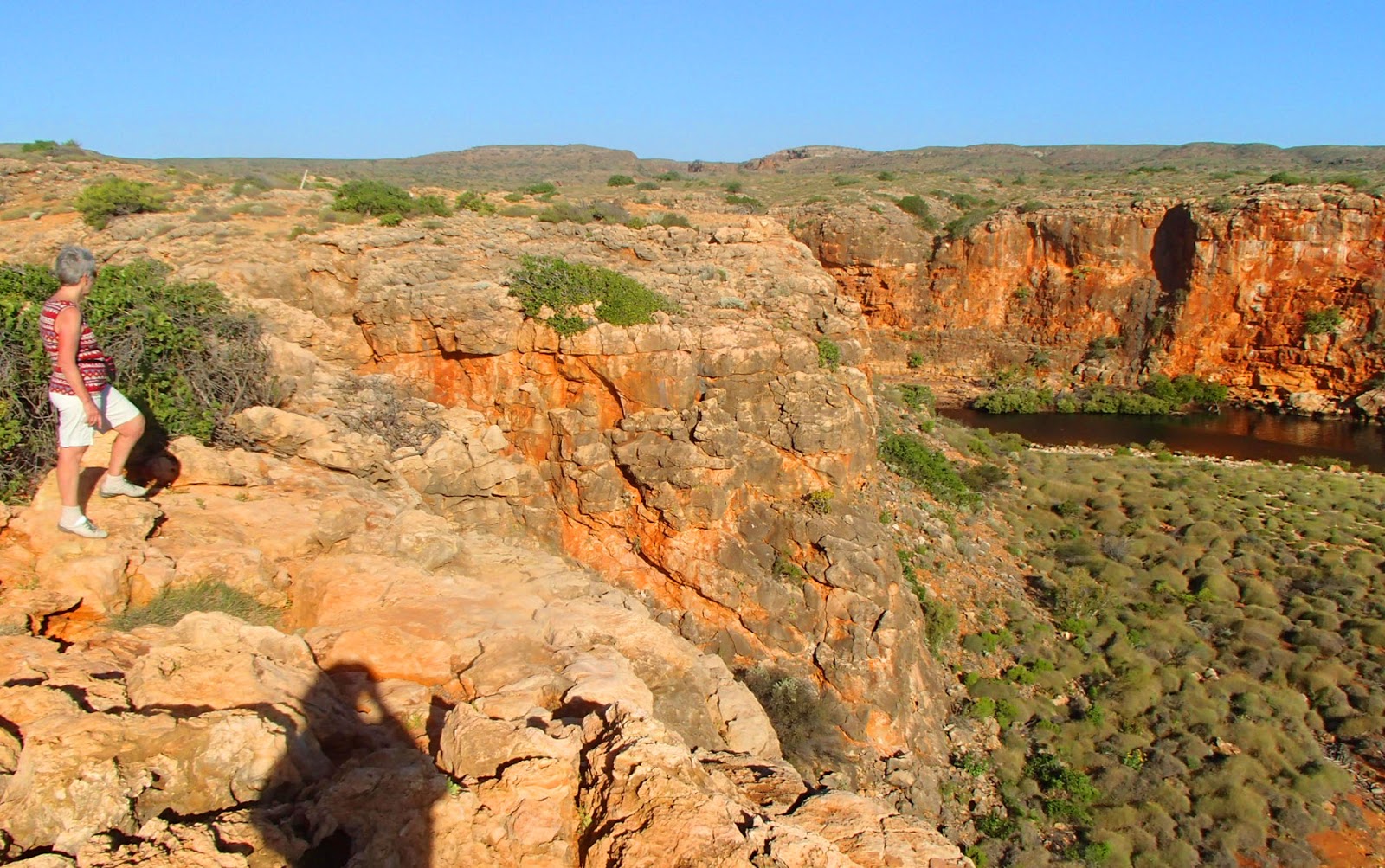
In the evening we walked up to Yardie River gorge past termite mounds and scrub. The National Park campsites along the shore were booked out, but we headed up to the
Yardie Homestead Caravan Park just on the park boundary to enjoy our sunset drinks.
 |
| Termite mound, Yardie Creek |
 |
| Kayak fisher and cormorants, Yardie Creek |
 |
| Yardie Gorge |
Next day we headed back to Exmouth and south to Coral Bay, restoring our calories at the traditional bakery where the Heart Foundation hasn't yet expunged the whipped cream from apple turnovers. We spent the rest of the day snorkel drifting over coral resembling ornate cabbages and blue tipped antlers, accompanied by swarms of fish.
Next morning we had a brisk early morning snorkel, then tackled the 600km drive south to Shark Bay. On the road, ordinary saloon cars were rare, red dusted four wheel drives towing outback caravans, and multi-trailer road trains more common.
At
Hamelin Pool we stopped off to visit the Stromatolites. At first sight underwhelming, they gain respect when you realise that these coral-like creatures have eschewed evolution for almost 4 billion years. I imagined an interview:
 |
| Stromatolites, Hamelin Pool |
Interviewer: "Can I just ask: why have you gone for 4 billion years without evolving?"
Stromatolite: "Well, when Charlie Darwin came up with this evolution thingy yesterday..."
Interviewer "Excuse me, Darwin's
Origin of the Species was published 150 years ago!"
Stromatolite: "Sorry - we've got a different sense of time than primates - anyway as I was saying we did wonder if we we'd let the life sciences side down a bit, but looking at where evolution has taken
homo sapiens - Donald Trump and reality TV for example - we think we made the right decision."
 |
| Termite proto-mounds, Shark Bay |
The draw card of Shark Bay is
Monkey Mia, where dolphins have learned to show up at the beach for breakfast, and tourists have learned to show up at the beach for selfies with the dolphins. A downside was that the dolphins learned unhealthy eating habits, so the Parks and Wildlife rangers now limit dolphin interaction to 20 minutes and 300g of gluten free healthy snacks, delivered by a select few tourists who persuade the rangers they are cute enough - a kid sized dolphin suit helps.
 |
| Dolphins observe human interaction at Monkey Mia |
We headed back to the main road, stopping at Eagle Bluff to see a dark shadow roaming the seagrass that we convinced ourselves was a dugong, and at the brilliant white, uniform-sized, shells of Shell Beach.
 |
| Sifting shells at Shell Beach |
The "only it's big" factor came into play again - Shark Bay had looked a minor detour on the map so we hadn't thought too much about fuel, but it's similar to driving from Wellington to Bulls and back, and 70km from the nearest fuel stop the gauge was reading empty. We were pleased to see the cluster of gum trees and and parked up road trains at the
Overlander Roadhouse.
 |
| Road through Kalbarri |
 |
| Murchison River, Kalbarri |
 |
| Bottlebrush, Kalbarri |
 |
| Kalbarri river mouth |
At
Kalbarri we headed back towards the sea through the wildflowers, stopping at the lookouts over the Murchison River. From Kalbarri town we enjoyed a morning bike ride down the coast to a scenically sited coffee cart, and Marg had her last snorkel at Blue Holes. A sign at a peaceful inlet warned of sharks.
 |
| Geraldton Wax flowers, Kalbarri |
 |
| Coffee on the Kalbarri coastal path |
 |
| Blue Hole |
Before GPS, this coast collected errant navigators: Dutch who failed to turn left for Batavia, and Brits who didn't head far enough south for Port Philip and Botany Bay. Before governing NZ,
George Grey had been wrecked on this coast, and with the help of the local Noongar people walked to Perth, so it was the George Grey highway we followed along the cliff tops dotted with scrub and wildflowers to Pink Lake, coloured by algae in its salt rich waters.
 |
| Murchison Rose |
 |
| Violet Eremaea |
 |
| Purple Flag |
 |
| Coral Gum |
 |
| Pink Lake |
The must-see wildflower at this time of year was the
Wreath Flower, which grows only in a very specific area. At the Geraldton Tourist Information Office we learned how specific this area was. "Head inland 100km to Mullewa, then the Mount Magnet mine road 30km to Pindar, then 10km up the dirt road to Beringarra Station, you'll see the flowers"
 |
| Pindar ensures its title of "Tidy Town of the Outback" |
We followed the directions and found the natural wreaths of flowers. The spot was very localised - they only grew over a 50m stretch of road. They used to grow on fire cleared land, but with increasing agriculture and fewer bush fires, they rely on the graded verges of the dirt road to bloom.
 |
| Marg pays her respects |
Wreathed out, we headed back to Mullewa for the night. Next morning we headed back out to the coast through the yellow fields of Everlastings at
Coalseam Conservation Park.
 |
| Truck art, Mullewa |
 |
| Coal Seam Park |
At Nambung we visited the
Pinnacles, hundreds of sandstone outcrops among the dunes. Geologists struggle to explain them (something to do with sand solidifying around tree roots or trunks). To the local Yued people, the pinnacles are the grasping fingers of young men who strayed into the forbidden dunes and were swallowed up. If they appeared in Wellington, we'd assume they were a Weta Workshop set for a new Tolkien movie.
 |
| Nambung Pinnacles |
Google navigated us across Perth to the Wicked depot, where we left Clint and Buddy in the care of two cheery guard dogs, keen to show their skill at crushing plastic drink bottles with their bare teeth.
 |
| End of the trip for Clint and Buddy |
A short bike ride and a couple of train trips got us to Fremantle, and the
Hougoumont Hotel, where our compact but comfortable room was well stocked with capsules for the Nespresso machine, and the Terns were welcomed to park up in the lobby with the hotel's complementary bike fleet.
Next morning we joined the magpies, rosellas and morning joggers on Memorial Hill, then biked down through the old terrace houses to the waterfront. Having spent a morning waiting on dolphins at Monkey Mia, it was a a surprise come on a pod gamboling in the Fremantle boat harbour. We breakfasted at the old Tramway depot by the Roundhouse where Aboriginal guerrillas were interned before being exiled to Rottnest, then headed to the Fremantle Market, where stalls stocked everything from boomerangs to chocolate to ingenious plastic bag closers.
 |
| Fremantle Market |
At the
Wreck Museum we saw the remains of the
Batavia, one of the Dutch ships that failed to make the turn. This shipwreck had a particularly dark history, its crew descending into a
Lord of the Flies nightmare of violence, but it left on the WA coast its hull and an ornate stone archway destined for the Javanese colony, along with a collection of domestic goods encapsulating 1600s Dutch life.
 |
| Snap! Folding bikes are a popular choice to get to the Wreck Museum |
 |
| Traditional Dutch jug at the Wreck Museum |
Lunch at the
Little Creatures Brewery, then we biked up the
coastal trail to Cottesloe and on to Kings park on the generous separated paths following the railway line. At Kings Park we checked out the wildflowers one last time, and traversed the
treetop walkway.
 |
| Warning sign, Kings Park |
 |
| Treetop walkway, Kings Park |
We biked on to the City West station and got the train back to Fremantle. Fellow passenger Elder Edwards wistfully admired our Terns - the Mormons now proselytise by public transport rather than the traditional bikes.
All too soon we were 10000m above the land we'd traversed, losing our sense of scale as we crossed the Nullarbor in an hour or so rather than days, on our way back to Sydney and home to Wellington. Maybe it's time to check out Texas.